
I spent almost 7 years living in Metro Manila and for the most part, I didn’t go out of my comfort zone, aka campus and workplace. (Well, not until the opportunity to travel abroad came). So, a few months before I left for Europe, I dared to visit one of the most historical places in the busy capital city of the Philippines.
One of the best reasons to go to Intramuros is to “experience” its rich history, or to get an idea of how it was particularly during the Spanish era. Intramuros is Latin for “within the walls”, and this old district served as the headquarters of the Spanish government in the Philippines. Also known as Ciudad Murada or “Walled City”, it features a 0.67 sq. kms or 0.26 sq mi series of stone walls and fortifications surrounding churches, houses, monuments, schools, convents, monasteries and government offices.
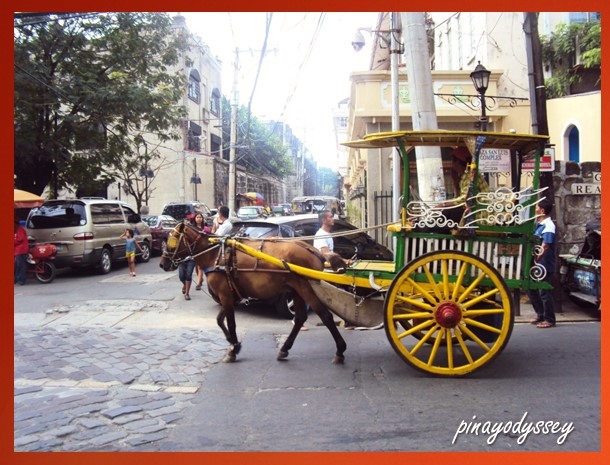
There are four, or five, ways to get to the city: by private vehicle, by taxi, by public jeepney, by bus, by train. (So, no excuses. Lol.) Once there, the best way to really explore the district is by foot or thru a walking tour, imo. Another option are the many kalesas or horse-driven carriages in the streets.
Here are some of the main attractions in and around Intramuros:
1. Plaza de Roma
Getting off from a public jeepney, I decided to find a nice spot in Plaza de Roma where I could sit and wait for my friends who agreed to meet up and join this gala (wandering) tour. This plaza is a perfect meeting place because it is in very close proximity to the Manila Cathedral, the Palacio del Gobernador, and the Ayuntamiento. And a strip of fast-food restaurants.
At the center of the plaza, you will find a statue of King Carlos IV of Spain. It was erected in 1824 to “thank” him for sending a shipment of smallpox vaccine to the country, or that’s what online sources say.

To keep an eye on yourself and your belonging is a good tip you will get from me, as all kinds of people dwell in Manila. However, I would also say that it would be worth the while to try and reach out to some of those people, especially the children. As I sat waiting, I noticed a little girl who seemed to have familiarized herself way too much with the streets. But the cutest thing was when she shouted, “Horse! Horse!” upon seeing a kalesa passing by. She sat beside me and accompanied me in waiting.
2. Palacio del Gobernador
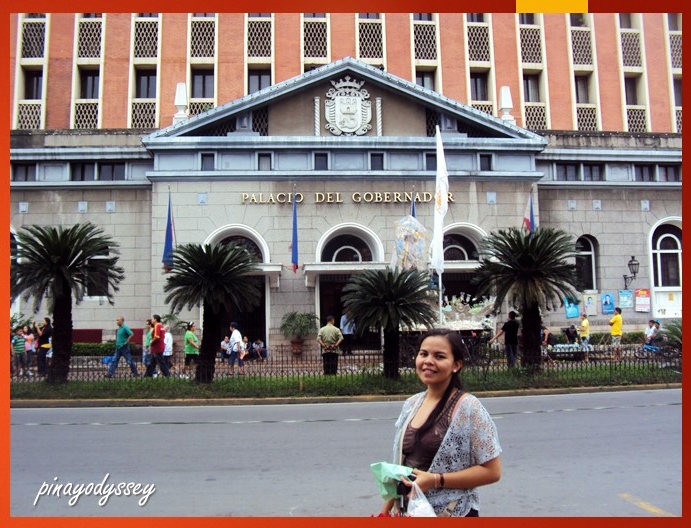
After almost an hour, I finally saw my travel buddies approaching. They are my “orgmates” (we’re members of an organization in the university). Since we were already in Plaza de Roma, we took some time to gaze at the 8-storey building, the Palacio del Gobernador. This structure was the official residence of the Spanish Governor-General who held the highest office in the country, representing the King of Spain.
3. Manila Cathedral
To the southeast of the plaza is one of the most important churches in the country, the Minor Basilica of the Immaculate Conception, or more commonly known as the Manila Cathedral. This church is the seat of the Roman Catholic Archdiocese of Manila, with Cardinal Luis Antonio Tagle as the current Archbishop. Originally built in the 1500s, the cathedral was destroyed several times by natural disasters. The images of the church you will see below is the eighth “rebuilding” and it was completed in the 1950s.
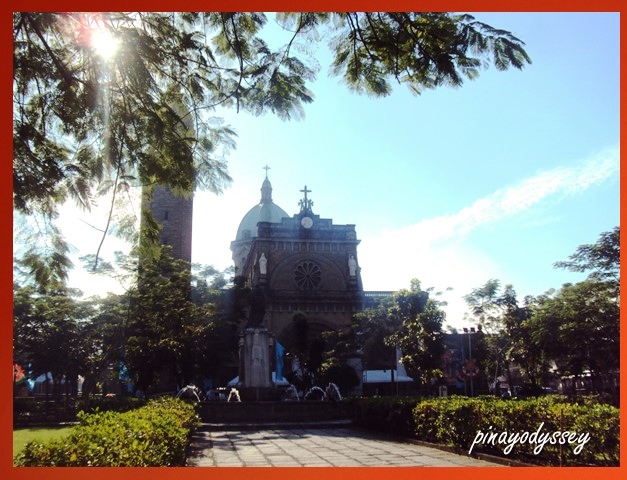


Manila Cathedral is also one of the most “in-demand” churches for weddings and other special occasions. (And one of the most expensive as well?)
4. Plazuela de Sta. Isabel
A few steps from the plaza is another square, much smaller though, called Plazuela de Sta. Isabel. Here, you will find a memorial monument dedicated to the victims of World War II.

5. Casa Manila Museum
Have you ever wondered how it’s like to live in an upper-class house in Manila during the Spanish colonial period? For 75 pesos (please check current price), you can get in Casa Manila Museum, a representation of a Spanish colonial home filled with antique furniture and artwork. Even the bathrooms were Spanish-inspired!

6. San Agustin Church
A UNESCO World Heritage Site, this Baroque church houses a beautiful interior with a high altar and trompe-l’œil ceilings. The external facade, however, can be deceiving as it looks like an ordinary Catholic Church in the Philippines. The first Governor-General of the country, Miguel Lopez de Legazpi (1502-1572), was buried in a tomb near the altar.
San Agustin Church was also named a National Historical Landmark by the Philippines Government in 1976.


The landmarks mentioned above are just some of the things you’d see in Intramuros! I haven’t even gotten to the walls yet. Sadly, I have to stop “writing”. Lol. But yeah, the perks of having lots of time to blog. So see you in my next entry as I continue to write about Manila. Hugs ♥ ALL PHOTOS AND VIDEOS ON THIS BLOG ARE MINE. 🙂 #spreadloveandpositivevibes




 PinayOdyssey
Leave a comment